 EN
EN
 AR
AR BG
BG HR
HR FR
FR DE
DE IT
IT JA
JA KO
KO PL
PL PT
PT RO
RO RU
RU ES
ES ID
ID LV
LV LT
LT SR
SR SK
SK SL
SL UK
UK VI
VI ET
ET HU
HU TH
TH TR
TR FA
FA GA
GA BE
BE HY
HY AZ
AZ KA
KA BN
BN LA
LA MN
MN NE
NE MY
MY KK
KK TG
TG UZ
UZ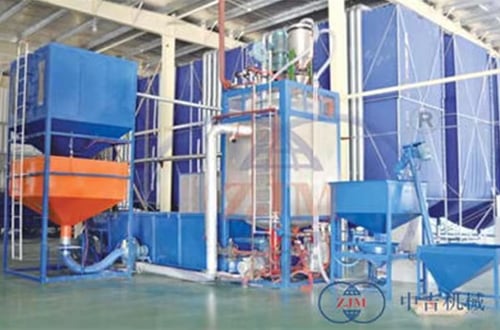
Introduction
A high-quality EPS (Expanded Polystyrene) product—whether it is an insulation board or protective packaging—is the result of a perfectly synchronized three-stage process. Many buyers focus only on the molding machine, but the truth is that the "solution" is only as strong as its weakest link. To achieve stable output, uniform density, and low energy costs, a factory owner must understand how the pre-expander, the molding machine, and the cutting equipment work together as a single ecosystem.
This systems thinking is crucial because EPS production is not just about changing physical shapes; it is a complex balance of thermodynamics and fluid dynamics. Any slight deviation in any part of the process, such as steam pressure fluctuations or insufficient cooling time, will be amplified through the production line, ultimately affecting the dimensional stability and mechanical strength of the finished product. Therefore, evaluating individual machines in isolation often leads to overall production inefficiency.
Buyer Risk: The Danger of System Mismatch
The biggest risk in EPS production is "bottlenecking." For example, if your pre-expander is too slow, your molding machine will sit idle, wasting energy. If your cutting equipment lacks precision, you will end up with high waste rates, even if the molding was perfect. Furthermore, EPS production is energy-intensive. A poorly integrated system can lead to energy bills that eat into your profit margins. Buyers need a balanced, energy-efficient system, not just a collection of machines.
System mismatch can also lead to a surge in maintenance costs. When a piece of equipment operates for long periods under overload or non-design conditions, the wear rate of its key components (such as valves, seals, and heating elements) increases significantly, thereby shortening equipment life and increasing downtime frequency for repairs.
The Three Pillars of EPS Production
1. The EPS Pre-expander (The Foundation)
This is where raw beads are treated with steam to expand. The goal here is "bead uniformity" and "density control." If the pre-expansion is uneven, the final product will have weak spots or inconsistent weight.
Advanced pre-expanders are equipped with precise temperature and pressure sensors that can adjust steam injection in real-time, ensuring that each batch of beads expands under optimal conditions. This not only improves the stability of subsequent molding but also reduces raw material waste caused by density fluctuations.
2. The EPS Molding Machine (The Core)
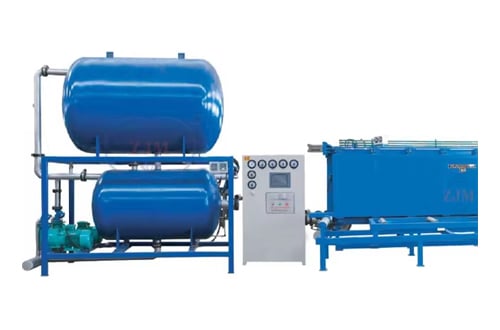
This machine uses heat and pressure to fuse the expanded beads into a specific shape or block. Key factors to evaluate here are the cycle time, vacuum efficiency, and the stability of the steam control.
An efficient vacuum system is critical for shortening the cooling cycle, as it rapidly removes residual steam and moisture from the mold. Meanwhile, a uniform steam distribution network ensures consistent heating across all parts of the mold, avoiding local over-curing or unfused areas, thereby guaranteeing product surface smoothness and internal structural integrity.
3. The Cutting Equipment (The Precision)
For insulation boards, accuracy is everything. The cutting system must deliver consistent dimensions (width within ±2 mm, thickness within ±1 mm) to ensure the panels fit together perfectly on a construction site.
Modern cutting equipment typically employs CNC technology and high-frequency hot wires to achieve precise cutting of complex shapes. Additionally, automated waste recovery systems can crush and recycle offcuts generated during cutting back into the pre-expansion stage, further reducing material costs and enhancing environmental performance.
Zhongji Machinery's Integrated EPS Solution
Zhongji Machinery provides a complete, stable, and highly efficient EPS production solution. A standout feature of Zhongji's EPS equipment is its energy performance. By adopting German-partnered technology, Zhongji has reduced energy consumption by 8%–15% compared to similar equipment in the market—a massive saving for high-volume producers.
Zhongji's pre-expanders are designed for precise density control and bead uniformity, ensuring the "raw material" for the next stage is perfect. Their molding machines are known for stable forming and high output, while their cutting systems utilize advanced control technology to minimize waste. Because Zhongji designs the entire system, every machine is matched in capacity and rhythm, eliminating bottlenecks and ensuring a finished product qualified rate of ≥99%.
This integrated design is also reflected in a unified central control system. Operators can monitor and adjust parameters for the entire production line through a single interface, enabling seamless data exchange and fault diagnosis. This high level of integrated automation not only reduces reliance on manual skills but also improves the transparency and traceability of the production process.
Practical Checklist for EPS Solutions
-
System Balancing: Is the capacity of the pre-expander matched to the molding machine? Calculate the theoretical hourly output of both to ensure the pre-expander can continuously supply sufficient and quality-stable beads, avoiding molding machine idling or bead accumulation and aging.
-
Energy Efficiency: Can the supplier prove an 8%–15% reduction in energy costs? Request comparative test reports based on the same capacity and raw material conditions, or refer to actual electricity meter readings from existing customers.
-
Density Stability: Does the pre-expander offer precise, controllable density settings? Test the actual output deviation under different density settings to verify the response speed and accuracy of its control system.
-
Cutting Precision: Is the cutting error within ±1 mm for thickness and within ±2 mm for width? Use high-precision measuring tools to take multi-point measurements on randomly selected finished products to confirm dimensional consistency across the entire panel area.
-
Integration: Is the entire line controlled by a central PLC for easy parameter switching? Check if the PLC system supports recipe storage functions to quickly switch production parameters for different specification products, reducing changeover time and human error.
Conclusion
In EPS production, the system is the product. By investing in a balanced solution where the pre-expander, molding machine, and cutting equipment are harmonized, you can achieve lower costs and higher quality. Zhongji Machinery's energy-efficient, German-partnered technology provides the technical edge needed to succeed in competitive insulation and packaging markets.
Choosing a partner like Zhongji, with a global perspective and deep technical accumulation, means you are acquiring not just a set of equipment, but an optimized, reliable, and future-oriented production platform. This will help you maintain a sustained competitive advantage under increasingly stringent quality standards and cost control requirements.